
A Deeper Question About Health
Have you ever stopped to think about how remarkable the human body really is?
Every moment of every day, trillions of cells are working together to keep us alive, producing energy, repairing tissues, communicating with each other, and responding to the world around us.
Yet when something goes wrong – when we are exhausted, experiencing chronic pain, struggling with our thyroid, or facing fertility challenges, we often focus on the symptom rather than asking a deeper question.
What is happening within the body that may be interfering with its ability to function as it should?
That question has guided much of my work as a practitioner of Chinese medicine and integrative healthcare. It is one of the reasons I find emerging research on red and near-infrared light therapy so interesting.
I already incorporate red light therapy routinely into my clinical practice at Red Lotus Wellness Center. I use it in individualized care for chronic pain, fertility concerns, and my No-Tox Botox™ Facial Rejuvenation system. So when I began exploring research on photobiomodulation and thyroid health, I was naturally intrigues by the findings..
Could specific wavelengths of light influence the cellular processes involved in thyroid function? Could they affect inflammation, oxidative stress, or the way our cells produce energy? And what does the clinical research actually tell us?
The Thyroid: A Small Gland With an Extraordinary Responsibility
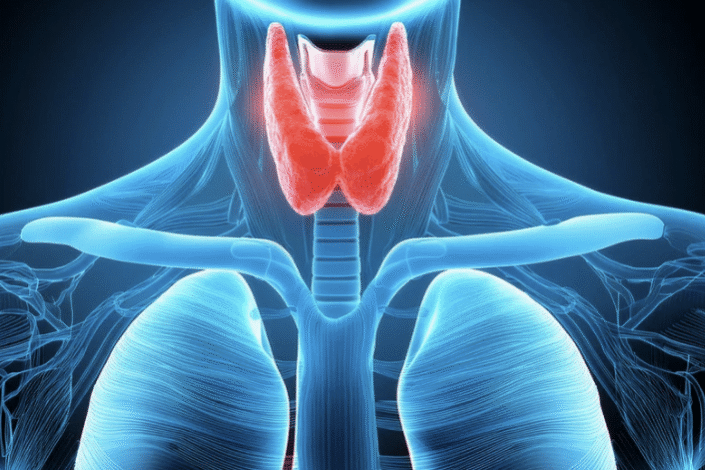
Your thyroid may be small, but its influence throughout your body is enormous. This butterfly-shaped gland helps regulate metabolism, body temperature, cardiovascular function, digestion, energy use, and reproductive health.
When thyroid function becomes compromised, symptoms may include fatigue, brain fog, constipation, weight changes, sensitivity to cold, dry skin, hair thinning or loss, or menstrual irregularities. Some people have hypothyroidism, others hyperthyroidism, while others have Hashimoto’s thyroiditis, an autoimmune condition in which the immune system attacks thyroid tissue.
Thyroid hormone replacement can be essential and highly effective. Yet some patients continue to experience symptoms even after thyroid levels are appropriately managed. That is where a broader conversation about health becomes valuable, not to abandon conventional treatment, but to consider other factors influencing how someone feels and functions.
What Does Light Have to Do With Our Cells?
Scientists have been investigating a process called photobiomodulation (PBM), which uses specific wavelengths of red or near-infrared light to influence biological activity. One principal area of investigation involves the mitochondria.
Mitochondria produce much of the ATP – adenosine triphosphate – that our cells use for energy. Researchers propose that some wavelengths of light interact with molecules involved in mitochondrial respiration, including cytochrome c oxidase. Under specific experimental conditions, this may influence cellular signaling, oxidative stress, and inflammatory pathways. [7]
A promising cellular mechanism is not the same thing as a proven treatment for thyroid disease.
That is why human clinical studies matter.
What Have Researchers Discovered About Light Therapy and the Thyroid?
A 2013 randomized, placebo-controlled trial enrolled 43 patients with hypothyroidism caused by chronic autoimmune thyroiditis. Participants received ten sessions of targeted 830-nanometer near-infrared laser therapy or placebo. At nine months, the active-treatment group required an average of approximately 38.6 micrograms of levothyroxine daily, compared with 106.9 micrograms in the placebo group. Researchers also reported reductions in thyroid peroxidase antibodies and changes in thyroid ultrasound appearance. [1]
These findings are intriguing, but this was a small trial with medication managed under a controlled research protocol. It does not mean patients should discontinue thyroid medication or expect the same results from a home red-light device.
Inflammation and Oxidative Stress
Oxidative stress occurs when the balance between oxidants and the body’s antioxidant defenses becomes disrupted. It is one of the physiological processes that integrative clinicians may consider when evaluating the broader picture of health.
In a 2024 randomized study involving 46 patients with Hashimoto’s thyroiditis, researchers evaluated photobiomodulation alongside conventional thyroid hormone treatment. The active-treatment group showed greater improvements in certain antioxidant measurements, including glutathione, and quality-of-life scores. However, there were no significant between-group differences in thyroid function or autoimmune markers at three months. [2]
In other words, some measures of oxidative stress and well-being improved without evidence in that trial that thyroid hormone production or autoimmune activity had improved. This is why we must look at the complete findings, not only the most exciting results.
Fatigue and Sleep
A 2026 randomized study involving 60 patients with Hashimoto’s thyroiditis examined fatigue, sleep quality, daytime sleepiness, and psychological symptoms. At three months, active treatment showed greater improvements in these measures than sham treatment. These are encouraging preliminary findings, but larger studies and longer follow-up are still needed. [3]
Putting the Research Together
A 2026 systematic review examined six human clinical studies involving photobiomodulation in chronic autoimmune thyroiditis. It identified potentially favorable results involving thyroid antibodies, hormone measurements, medication requirements, and quality of life, while emphasizing small samples, differing protocols, and co-interventions that make interpretation difficult. Larger, standardized randomized trials are needed. [4]
For now, thyroid-directed photobiomodulation is an emerging area of research, not an established treatment for Hashimoto’s or hypothyroidism. It has not been shown conclusively to regenerate thyroid tissue, cure autoimmune disease, or replace thyroid medication.
Is All Red Light Therapy the Same?
Absolutely not. The thyroid studies have generally investigated targeted near-infrared laser treatment, often around 820-850 nanometers, under specific clinical protocols. These findings cannot simply be transferred to every commercial LED panel or home device.
Wavelength, energy delivered, duration, tissue characteristics, and device design all matter. More light is not necessarily better. People with thyroid nodules, a history of thyroid cancer, or other conditions requiring monitoring should discuss any proposed direct neck treatment with their allopathic medical clinician.
How I Use Red Light Therapy at Red Lotus Wellness Center
For me, this research is meaningful because photobiomodulation is not simply something I have been reading about. Red light therapy is a modality I routinely incorporate into patient care at Red Lotus Wellness Center.
Chronic pain and musculoskeletal concerns. I incorporate it into individualized plans for patients dealing with persistent discomfort, muscle tension, and related concerns. Photobiomodulation has been investigated for pain and tissue recovery, although outcomes vary by condition and protocol.
Fertility and reproductive wellness. I also use red light therapy as an adjunctive modality alongside acupuncture, Chinese medicine, and appropriate medical care. I want to be very clear: clinical research has not established that red light therapy reliably improves conception, implantation, pregnancy maintenance, or live birth rates.
No-Tox Botox Facial Rejuvenation Program. Red light therapy is part of a non-injectable approach to facial rejuvenation that may also incorporate cosmetic acupuncture and individualized wellness care. Some studies of red and near-infrared light suggest modest improvements in skin appearance, texture, or fine lines.
What connects these three areas is not simply the use of a device. It is the philosophy behind how I practice. Whether someone comes to me with chronic pain, fertility concerns, or a desire to age gracefully, I begin by asking what is happening beneath the surface and how we can thoughtfully support the person as a whole.
Why Thyroid Health Matters on the Fertility Journey
Thyroid hormones play essential roles in reproductive physiology and early pregnancy. Untreated or inadequately managed hypothyroidism can affect ovulation and increase the risk of pregnancy complications. For people preparing for pregnancy, facing fertility challenges, or experiencing recurrent pregnancy loss, thyroid evaluation may be part of a comprehensive assessment.
Depending on the individual’s history, testing may include TSH, free T4, and thyroid antibodies. Results must be interpreted in context: not every positive antibody result requires medication, and not every fertility concern is caused by thyroid dysfunction.
Yang Shen: The Art of Nourishing Life
This brings me to a philosophy deeply woven into our work: Yang Shen – the Art of Nourishing Life. Rooted in classical Chinese philosophy and medicine, Yang Shen invites us to think about health not only as the absence of disease, but as the ongoing practice of nurturing and preserving life.
It is about how we nourish ourselves, rest, move, respond to stress, and live through the different seasons of our lives. Too often, people push through exhaustion or wait until symptoms become overwhelming before seeking help. Yang Shen encourages awareness, balance, nourishment, and consistency.
Yang Shen is a philosophy of living, not a scientific explanation for photobiomodulation. Yet both invite us to consider the conditions that support our bodies and our well-being.
The Lotus and the Peacock: Resilience, Vitality, and Renewal
At Red Lotus Wellness Center, the lotus and the peacock are more than decorative symbols. They express how I think about health and the human experience.
The lotus rises from the mud and blossoms above the water. To me, it represents rootedness, resilience, and renewal. It reminds us to look beneath the surface: What conditions are influencing the body? What needs nourishment? What deserves our attention?
The peacock represents dignity, vitality, confidence, beauty, and the full expression of life. Not beauty in a superficial sense, but the radiance that comes from feeling connected to yourself, moving comfortably in your body, and participating fully in your life.
That philosophy is especially meaningful in my No-Tox Botox™ Facial Rejuvenation system. Facial rejuvenation is not about erasing the years or changing who someone is. It is about supporting skin health and helping people explore ways to feel confident and radiant in their own skin.
We nourish our roots so that we may flourish, from the inside out.
Final Thoughts: Nourishing Life, One Thoughtful Step at a Time
One of the things I love most about practicing Chinese medicine is the understanding that health is dynamic. Our bodies continually adapt to our environment, stress, nourishment, sleep, medical conditions, and the different stages of life.
I believe we should remain curious about new discoveries while being equally committed to sound evidence and thoughtful clinical judgment. Just because a treatment is natural, noninvasive, or innovative does not automatically mean it is right for everyone.
At Red Lotus Wellness Center, my philosophy is to bring together the wisdom of Chinese medicine, the principles of Yang Shen, and the evolving evidence of modern healthcare. The lotus reminds us to nurture our roots. The peacock reminds us of the vitality and dignity with which we deserve to live, and Yang Shen reminds us that nourishing life is a lifelong practice.
Health is not simply about getting through another day. It is about creating the conditions that allow us to live more fully, with awareness, resilience, and vitality.
Let’s Continue the Conversation
Are you struggling with persistent fatigue, thyroid concerns, chronic pain, hormonal changes, or fertility challenges? Perhaps your laboratory results look fine, yet you still do not feel well. Or perhaps you are curious about acupuncture, Chinese medicine, or a more comprehensive approach to your health.
I invite you to connect with us at Red Lotus Wellness Center to discuss your concerns and explore an individualized, evidence-informed approach to care.
Your health deserves thoughtful attention. And your journey deserves to be heard.
Dr. Yvonne K. Scarlett Red Lotus Wellness Center The Lotus & the Peacock | Yang Shen: The Art of Nourishing Life
References and Clinical Research
- Höfling DB, et al. (2013). Low-level laser in the treatment of patients with hypothyroidism induced by chronic autoimmune thyroiditis: a randomized, placebo-controlled clinical trial. Lasers in Medical Science, 28, 743-753. DOI: 10.1007/s10103-012-1129-9. PubMed
- Tunç S, et al. (2024). The effect of low-level laser therapy on the oxidative stress level and quality of life in patients with Hashimoto’s thyroiditis. Free Radical Research, 58(4), 249-260. PubMed
- Tunç S, Altuntaş ŞL, Atmaca M. (2026). The effect of photobiomodulation therapy on fatigue and behavioural status in patients with Hashimoto’s thyroiditis. Lasers in Medical Science. PubMed
- Photobiomodulation Therapy in Chronic Autoimmune Thyroiditis: A Systematic Review of Molecular Mechanisms and Clinical Applications. (2026). International Journal of Molecular Sciences. PMC
- Höfling DB, et al. (2010). Low-level laser therapy in chronic autoimmune thyroiditis: a pilot study. PubMed
- Höfling DB, et al. (2018). Safety and efficacy of low-level laser therapy in autoimmune thyroiditis: long-term follow-up study. PubMed
- Hamblin MR. (2018). Mechanisms and mitochondrial redox signaling in photobiomodulation. Photochemistry and Photobiology, 94(2), 199-212. PubMed
- American Thyroid Association. Hashimoto’s thyroiditis: patient education and clinical information. thyroid.org
cf
Medical disclaimer: This article is educational and is not individualized medical advice. Photobiomodulation remains investigational for autoimmune thyroid disease and has not been established to improve fertility outcomes. Do not stop or adjust prescribed thyroid medication without your treating clinician. Seek appropriate individualized care for thyroid symptoms, pregnancy planning, or fertility concerns.


